Park Chan-Wook’s No Other Choice is neither the first nor most faithful film adaptation of Donald E. Westlake’s satirical crime novel The Ax, the former of which initially discouraged the director himself from even making it in the first place. Nevertheless, by way of putting his own sordid spin on this same book, he still manages to skillfully shape its sharp social commentary into the finest one to date. If Yorgos Lanthimos’ latest twisted thriller Bugonia reimagined a South Korean work (Save the Green Planet!) for Western audiences, No Other Choice is the total inverse of that. In bringing this American story over to his home country, Park Chan-Wook alters far more than just its greater cultural backdrop. Despite roughly having the same premise, it is otherwise about as different from The Ax as it could possibly be. Both works are darkly gripping in their own distinct way, but No Other Choice particularly soars as a razor-sharp send-up of societal inequality.
As No Other Choice begins, its protagonist Man-Su (portrayed by Lee Byung-hun) is a happy veteran employee of the papermaking company “Solar Paper”, enjoying a pleasant barbecue with his loving family just outside their fancy home. It’s the type of picturesque scene that almost feels too good to be true, and, mere moments later, very much will be. When Solar Paper gets bought out by Americans, Man-Su soon becomes one of many employees who are laid off in the shuffle. Finding himself with no employment, no stable income, and therefore no means of financially supporting his family, he is forced into grave measures to regain the life he once had. All that’s standing in the way of his potential new career is a few other applicants, who he is desperate to get ahead of at any and all costs. So desperate, in fact, he becomes deadset on literally bumping them all off one by one.
Westlake’s original novel may have the same basic setup as this adaptation, but it takes that in a different direction altogether. In his version of the story, the protagonist—whose original name is “Burke Devore”—quickly becomes a cold, calculated killer who never lets anything else stand in his way, no matter what potential cost that might come at. Much of the novel is so relentlessly grim at every possible turn, a film version being anything less than stomach-churning seems impossible. The first such adaptation by Costa-Gavras (which keeps the same title as its source material), although admittedly bogged down by TV movie-ish presentation, does indeed hew closer to the more solemn mood of Westlake’s novel. Park Chan-Wook’s adaptation, on the other hand, completely throws that out the window in favor of crafting a pitch-black farce.
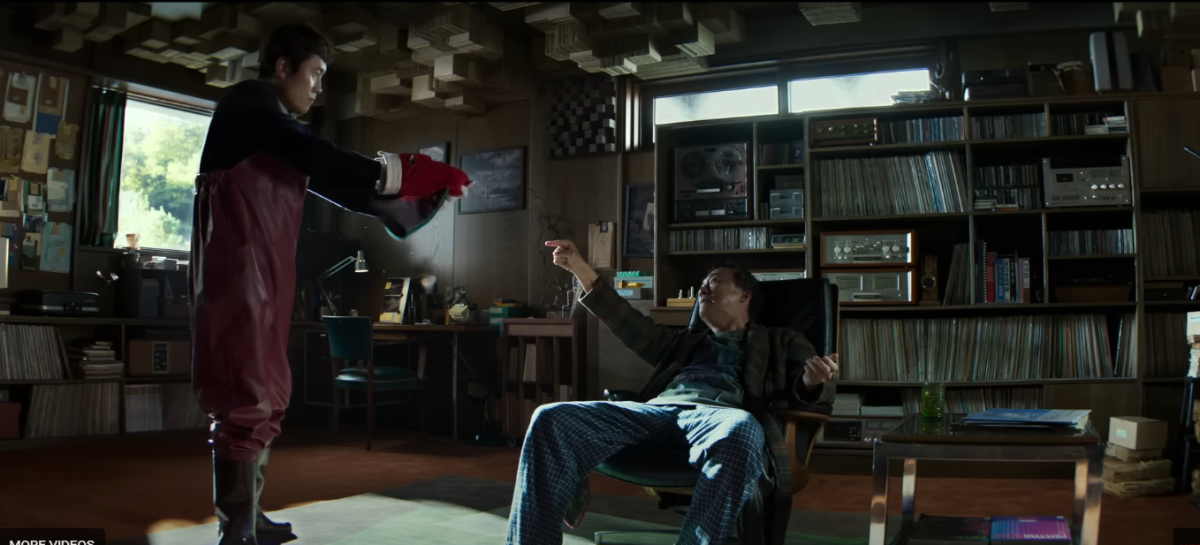
Given Park Chan-Wook’s reputation as an unflinching cinematic provocateur, it’s a real surprise that he, of all directors, would tone down the source material’s most disturbing elements. That isn’t to downplay how violent No Other Choice still becomes in its own right, but it largely leans more towards humor without sacrificing the story’s serious stakes. What really adds to this adaptation’s more tongue-in-cheek nature is how terrible Man-Su is at killing his targets, totally flying in the face of the more methodical murderer Westlake originally envisioned. In making its central character an incompetent buffoon at each and every assassination he attempts, Park Chan-Wook transforms this story from a bleak meditation on the nature of human psychopathy into a caustic comedy of errors. Skillfully veering between silliness and shock value, he somehow manages to mold such morbid material into a delightful crowd-pleaser guaranteed to elicit uproarious laughter.
When Westlake penned The Ax in 1997, he was drawing inspiration from some of his friends losing their own jobs to corporate downsizing, along with his parents’ experiences with economic hardship during the Great Depression. His resulting thesis at the time was about how callous corporations can be in laying off the middle-class workers who depend on them for a living, ultimately forcing these common folk against each other. No matter how cruel the protagonist’s actions become in either version of this story, they only boil down to a last-ditch effort to sustain himself and his family in an unforgiving capitalist system. No Other Choice expands on that by demonstrating how AI automation can be—and, more often than not these days, is—used to replace human workers, a far more prescient point to make right now than ever before. The film’s final scene underscores this greater theme with cutting cleverness, making it quite the timely note to end this story on.
While No Other Choice may showcase Park Chan-Wook working in a different tonal register than usual, it still displays all the impeccable craftsmanship one would expect from him. Like much of the very best South Korean cinema, every aspect of its presentation is so skillfully elegant. From Jo Yeong-wook’s sublime orchestral score to Kim Woo-hyung’s creatively staged cinematography, this is truly a filmmaking masterclass of the highest order. Even the transitional shots are a marvel of superb visual storytelling, ranking among the film’s finest imagery by far. These exceptional technical elements alone make No Other Choice feel like one of the year’s greatest cinematic achievements, but for them to be utilized in service of such a thoughtfully macabre story is all the more satisfying. At this point in his long-spanning career, Park Chan-Wook’s specific directorial approach has now become incredibly refined, making his confident control of the camera in this particular film feel downright effortless.
Despite not really being the type of movie one might expect after reading Westlake’s original novel, No Other Choice is nonetheless able to do his vision justice as only a director like Park Chan-Wook could. Compared to the more extreme nature of his past output (perhaps most famously, 2003’s Oldboy), this may be one of his more surprisingly tame efforts in recent years, but is far from ever being toothless either. On top of his unbeatable filmmaking talent, Park Chan-Wook also demonstrates here that he has his finger right on the pulse of our 21st-century world, all without becoming preachy. Although Costa-Gavras might have made the more faithful adaptation of Westlake’s novel about twenty years earlier, in reshaping it into something so dramatically different, Park Chan-Wook has crafted the superior film version of this modern literary masterwork. No matter which way one might look at it, for the Academy to entirely turn their nose up at such a fantastic filmmaking feat is just baffling.